

Long road to travel but shimmers of light ahead?
Towards the end of each year, taking into account all the available data and statements Climate Action Tracker update their projections for global temperature rises.
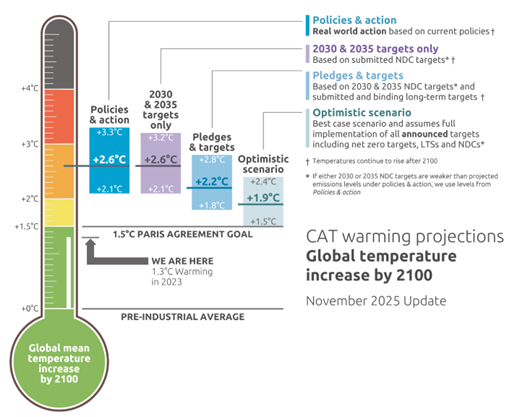
On first glance, it does not look good. The Optimistic scenario of a 1.9°C rise in temperature versus the agreed Paris target of 1.5°C is not ideal, and creates significant risks and unpredictability to climate patterns and society as a whole.
Source: Climate Action Tracker (2025).Climate Analytics / New Climate Institute team https://climateactiontracker.org/global/cat-thermometer/
When reviewing this data against previous years, it becomes clear in all scenarios except Policies & Action the median projected temperature all rise by 0.1°C
However, in real world Policies and action we see this fall from 2.7°C to 2.6°C.
While 2.6°C is significantly higher than the aim to limit warming to a 1.5°C rise, this small reduction is an indication that real action is beginning to have an impact.
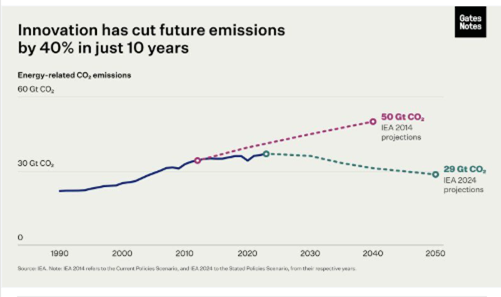
The sign it is having an effect is supported by other data and a recent LinkedIn post by Bill Gates (Microsoft Co-founder) highlighted “In 2014, the world was on track to emit 50 billion tons of CO₂ by 2040. Now, that projection is down to 30 billion. We still have a long way to go, but innovation is helping us close the gap.”
Source: LinkedIn; Gates Notes and IEA https://lnkd.in/gcna_FvF
The difference is not due to economic stagnation or de-industrialisation as energy demand continues to grow year on year.
The difference is due to the changing energy mix and real world technological changes and improvements where we see renewables such as solar and wind play a much larger part in global power generation (34.3%, source Ember), combined with reduced consumption due to technological efficiency across many processes and areas.
Bill Gates’ message is simple: innovation bends the curve.
The 20 Gt CO₂ or 40% reduction is the impact of 10 years work. If the same positive action and innovation is harnessed to support further development combined with re-modelling and reinventing industrial and business processes then there are clear signs that Policies and Action can keep driving down both CO₂ emissions and the projected temperature rise.
There is a long way to go, however, this illustrates that if all organisations can contribute to carbon reduction or energy saving, it will help shape better outcomes. We still need to adapt and develop resilience but we may also be able to reduce some of the risks.